
Rank Tracker: Monitor Search Rankings, Map Pack Presence & Visibility Over Time
Track keyword positions by project, locale, and device — see exactly when you gain or lose ground, and whether you're showing up in the local Map Pack.
No credit card required. Free tier includes tracked keywords on day one.
Check Your Google Ranking
Enter any domain and keyword to see its current Google position.
Powered by live Google SERP data
What is a rank tracker?
A rank tracker is a tool that monitors where your site ranks in search results for a chosen set of keywords, tracking how those positions change over time. SignalSumo organizes tracking by project, lets you target a specific locale, language, and device, and reports ranking movement, search visibility percentage, and whether a keyword appears in the local Map Pack — not just a single snapshot.
Key Takeaways
- SignalSumo tracks keyword positions on Google and Bing daily, separated by desktop and mobile.
- Rankings are organised by project and can target any locale, language, and device combination.
- The Search Visibility Score reflects your estimated share of total available clicks for tracked keywords.
- Local Map Pack tracking shows whether a keyword triggers a 3-Pack result and whether your site appears in it.
- Rank alerts notify you when positions change beyond a threshold you set — so you react before traffic drops.
- Historical rank graphs let you correlate traffic dips with specific position changes over any date range.
Need more keywords? Buy the keywords, not a bigger plan.
A Rank Tracking package adds keyword capacity on its own monthly cycle and stacks on top of whatever plan you are on. It unlocks the whole area it belongs to — Rank Tracker, Keyword Research, the Keyword Manager and Competitors — so you are not paying for seats, audits or API calls you did not ask for.
up to 5,000 on the largest package
- Stacks on any plan, including Starter
- First check runs within a day, on every tier
- Cancel or change tier without touching your plan
Rankings move every week — most sites only notice after traffic drops
Waiting for analytics traffic charts to drop means you're already losing revenue. Spot ranking issues proactively.
Unnoticed drops
A slow slide from position 4 to position 14 rarely gets flagged until organic traffic has already fallen off.
Invisible Map Packs
For local-intent keywords, ranking organically without appearing in the Map Pack still means losing the clicks that matter most.
Device discrepancies
A keyword performing well on desktop can rank very differently on mobile — and most setups only show you one.
Manual checking fails
Searching a handful of terms by hand might work for a week; it falls apart past a dozen keywords.
Everything you need to know if your rankings are moving — and which direction
Professional tracking capabilities packaged inside a fast, reliable dashboard interface.
Project-Based Organization
Group tracked keywords under active domain projects, so results for each site stay separate and organized. Add keywords individually or in batches straight from a Keyword Research Tool search.
Locale & Device Targeting
Configure the regional search engine domain, language, and desktop or mobile viewport for every keyword you track.
Rank Visibility Graphs
See historical line graphs of ranking improvements, search visibility percentage, and average keyword position over time — not just a single number.
Movement Alerts
Daily ranking changes are flagged with clear visual indicators — green for gains like "+5," red for drops like "-2" — so movement is obvious at a glance.
Map Pack Tracking
See whether a keyword appears in the local Google Map Pack, tracked as its own signal alongside standard organic position.
Position Distribution Buckets
Keywords are clustered into Top 3, Top 10, and Top 100 performance groups, so you can see overall visibility at a glance instead of scanning every row.
Smart Update Scheduling
New keywords get a baseline ranking check within 24 hours of being added, then refresh on a 5-day cycle after that — frequent enough to catch real movement without burning through API costs on noise.
From adding a keyword to tracking real movement in four steps
Get up and running in minutes. Our tracking crawler handles the heavy lifting.
Select a project
Choose the active domain project you want to track keywords under.
Add keywords & set locale/device
Enter keywords individually or in batch, and configure region, language, and desktop or mobile.
Baseline check runs within 24 hours
Every new keyword gets an initial position check to establish where you're starting from.
Track movement over time
Watch position changes, visibility trends, and Map Pack presence update on the regular tracking cycle.
See exactly what ongoing rank tracking looks like
Clean metrics distributions and search intelligence features built directly into your active dashboard view.
4 keywords
11 keywords
22 keywords
Search Visibility Distribution
Monitor your search visibility percentage (the share of estimated search click-throughs your site receives based on its rankings) over time. High visibility means major ranking keywords reside in the Top 3 positions.
| Keyword | Position | Change | Device | Map Pack Flag |
|---|---|---|---|---|
| emergency plumber chicago | #3 | +5 | Mobile | ✅ In Map Pack |
| best plumbing software | #12 | -2 | Desktop | — Not applicable |
| 24 hour plumber near me | #6 | +1 | Mobile | ✅ In Map Pack |
| plumbing invoice template | #34 | 0 | Desktop | — Not applicable |
Example output for a sample project. Your results will reflect your own tracked keywords.
Why track rankings with SignalSumo instead of checking by hand — or a generic free checker
Save dozens of hours monthly with our automatic scheduling and reporting tools.
| Feature | SignalSumo | Manual Checking | Generic Free Checkers |
|---|---|---|---|
| Map Pack tracking | Tracked as a distinct signal | Not feasible at scale | Rarely included |
| Desktop / mobile split | Tracked separately per keyword | One at a time, manually | Often desktop-only |
| Movement alerts | Automatic, color-coded | None — manual comparison | Limited or absent |
| Position distribution | Top 3 / Top 10 / Top 100 buckets | Not available | Rarely included |
More keywords as you grow
Every paid plan includes the full toolkit. Plans differ only in how much you can use.
Explore More SEO Intelligence Tools
Technical SEO Audit
Crawl your site to find broken links, server errors, and page speed issues.
Audit website crawler →Backlink Checker
Audit your full backlink profile and identify referral linking targets.
Backlink checker →Keyword Research Tool
Generate high-volume search phrases and evaluate keyword difficulty scores.
Research keywords →Competitor Analysis
Compare organic keyword metrics and analyze shared search query gaps.
Analyze gaps →Backlink Gap Tool
Compare your backlink profile against competitors to find link opportunities.
Backlink gap tool →AI SEO Growth Plan
Consolidate audits and backlink profile data into a prioritized 30-day roadmap.
AI SEO Growth Plan →Backlink Monitoring
Track new and lost backlinks in real time with automated refresh cycles and authority-loss alerts.
Backlink monitoring →How Rank Tracking Fits Into Your SEO Workflow
Rank tracking isn't a one-time check — it's the feedback loop that tells you whether everything else you're doing is working. Here's how to use it systematically.
Establish a Baseline
Before publishing any new content or building a single link, add your target keywords and record where you start. Rankings are meaningless without a before-and-after reference point. Group keywords by page so each landing page has its own ranking story.
Segment by Device and Locale
Google serves meaningfully different results on mobile vs. desktop, and city-level searches have entirely separate ranking pools from national queries. If you track only one view, you're optimizing blind. Track each keyword across the device and location combinations that matter to your business.
Monitor Map Pack Separately
For local businesses, a Map Pack appearance at position 1 is worth more than an organic result at position 3. Track Map Pack presence as a distinct signal — entering it, losing it, or gaining a position within it represents different traffic and intent than standard organic rankings.
Act on Movement, Not Just Numbers
A keyword dropping from #4 to #9 in a week deserves immediate investigation — did a competitor publish fresh content? Did you change a title tag? Movement is the signal; the absolute position is just context. Use ranking changes as triggers to audit the page and its backlink profile.
Understanding How Google Ranking Works
Google's ranking algorithm evaluates hundreds of signals, but the ones that move rankings most consistently fall into three buckets: relevance, authority, and experience.
Relevance
How well your page's content, title, headings, and entity coverage match what the user actually wants. This is where keyword research and content strategy connect directly to ranking outcomes. Pages that satisfy search intent at depth outrank pages that merely contain the keyword.
Authority
The quantity and quality of referring domains pointing to your page and site. A single link from a DR 70 industry publication moves rankings more than 50 links from low-authority directories. Authority is why backlink monitoring and gap analysis are not separate disciplines from rank tracking — they're the inputs that determine your ceiling.
Experience
Core Web Vitals, page load speed, mobile-friendliness, and structured data all contribute to how Google evaluates user experience. Technical issues identified in a site audit — slow LCP, layout shifts, missing schema — are ranking blockers that suppress even high-authority, highly relevant pages.
The Rank Tracking Cadence That Works
Check for sudden drops (>5 positions) on your highest-traffic pages. These are algorithm update signals or technical emergencies.
Review top-10 movement across all active projects. Identify which pages are climbing and which are stalling — and why.
Report on visibility trends across position distribution buckets (Top 3 / Top 10 / Top 100). This is the metric that shows compound SEO progress.
Frequently Asked Questions
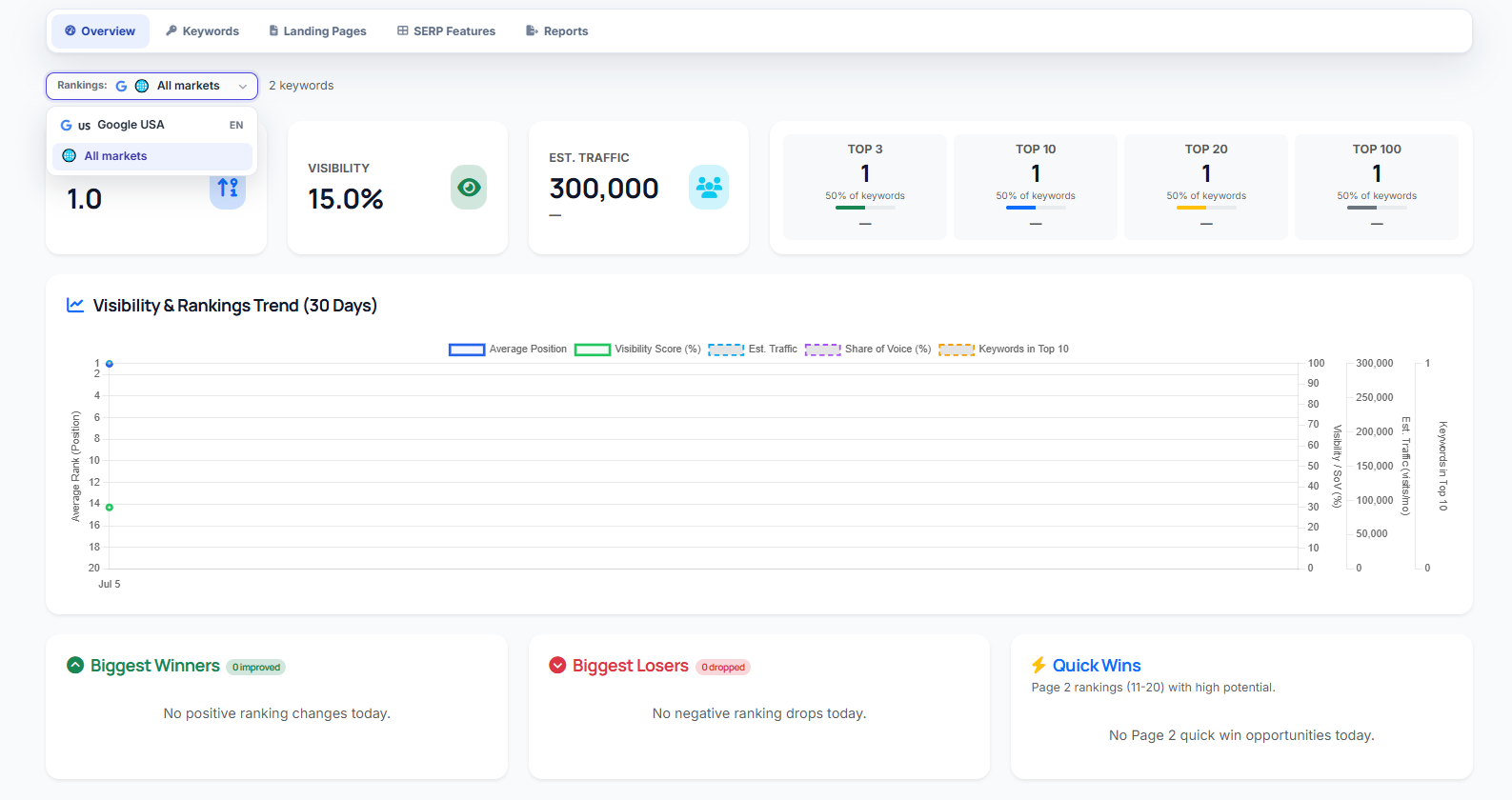
assets/img/sample-report/rank-tracker/1-overview.png and refresh — it will appear here.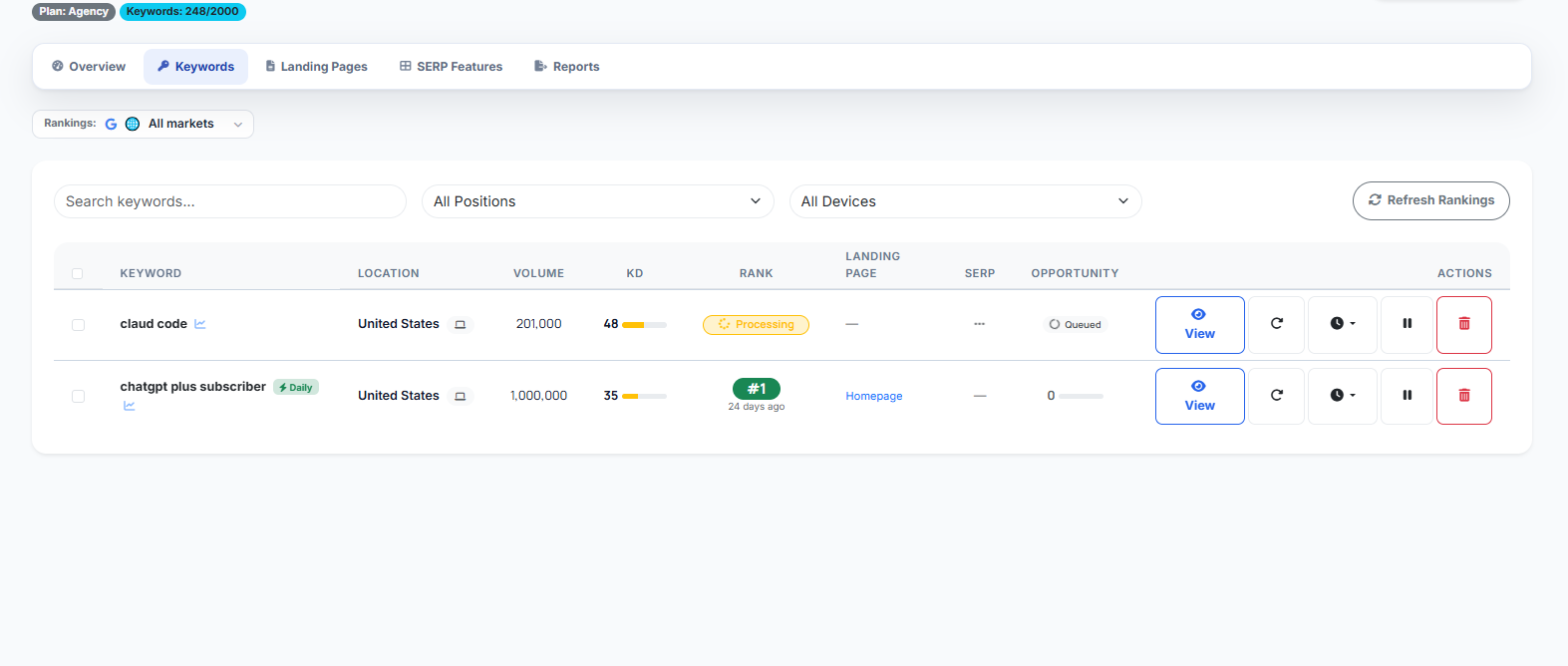
assets/img/sample-report/rank-tracker/2-keywords.png and refresh — it will appear here.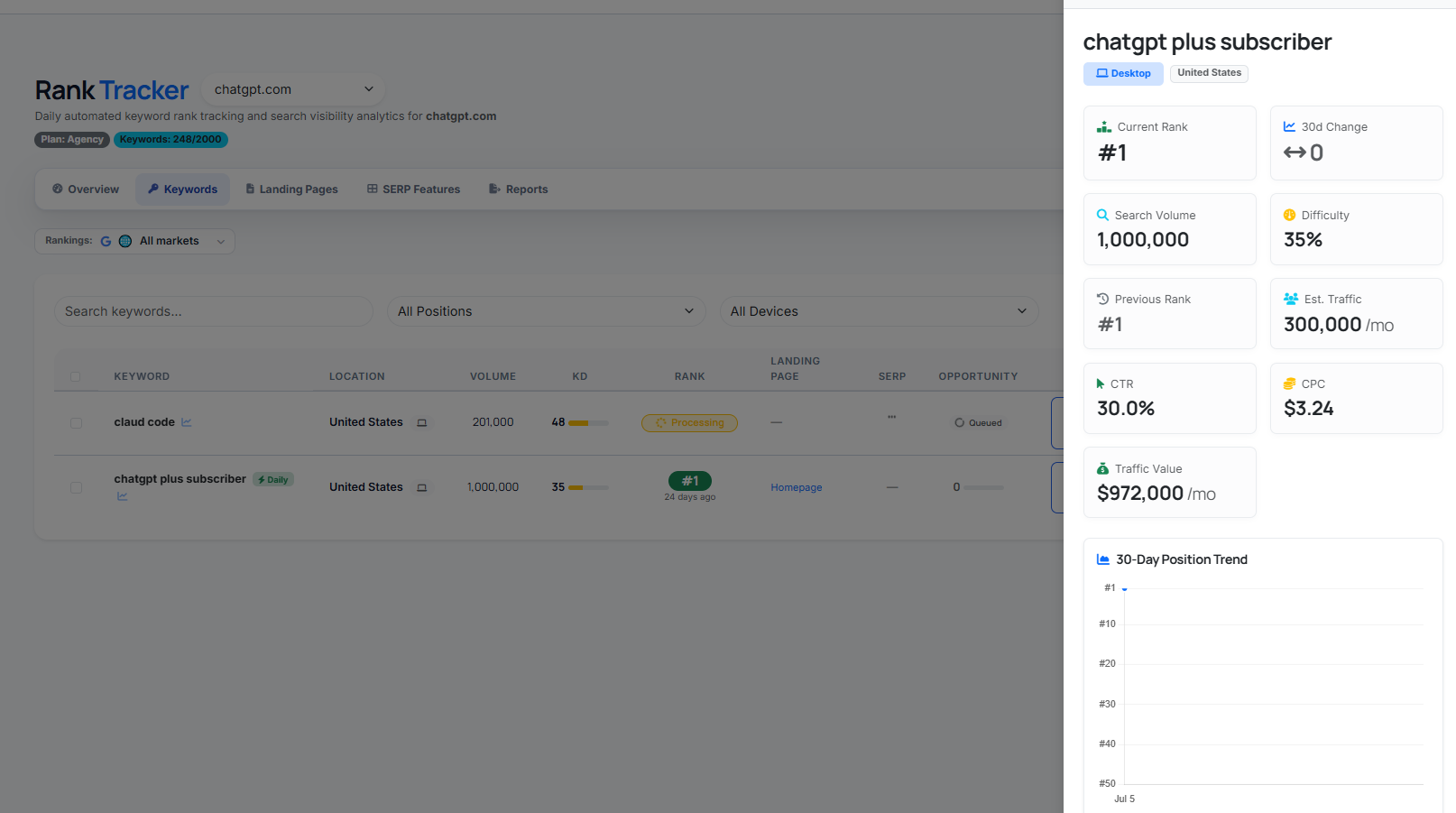
assets/img/sample-report/rank-tracker/3-keyword-drawer.png and refresh — it will appear here.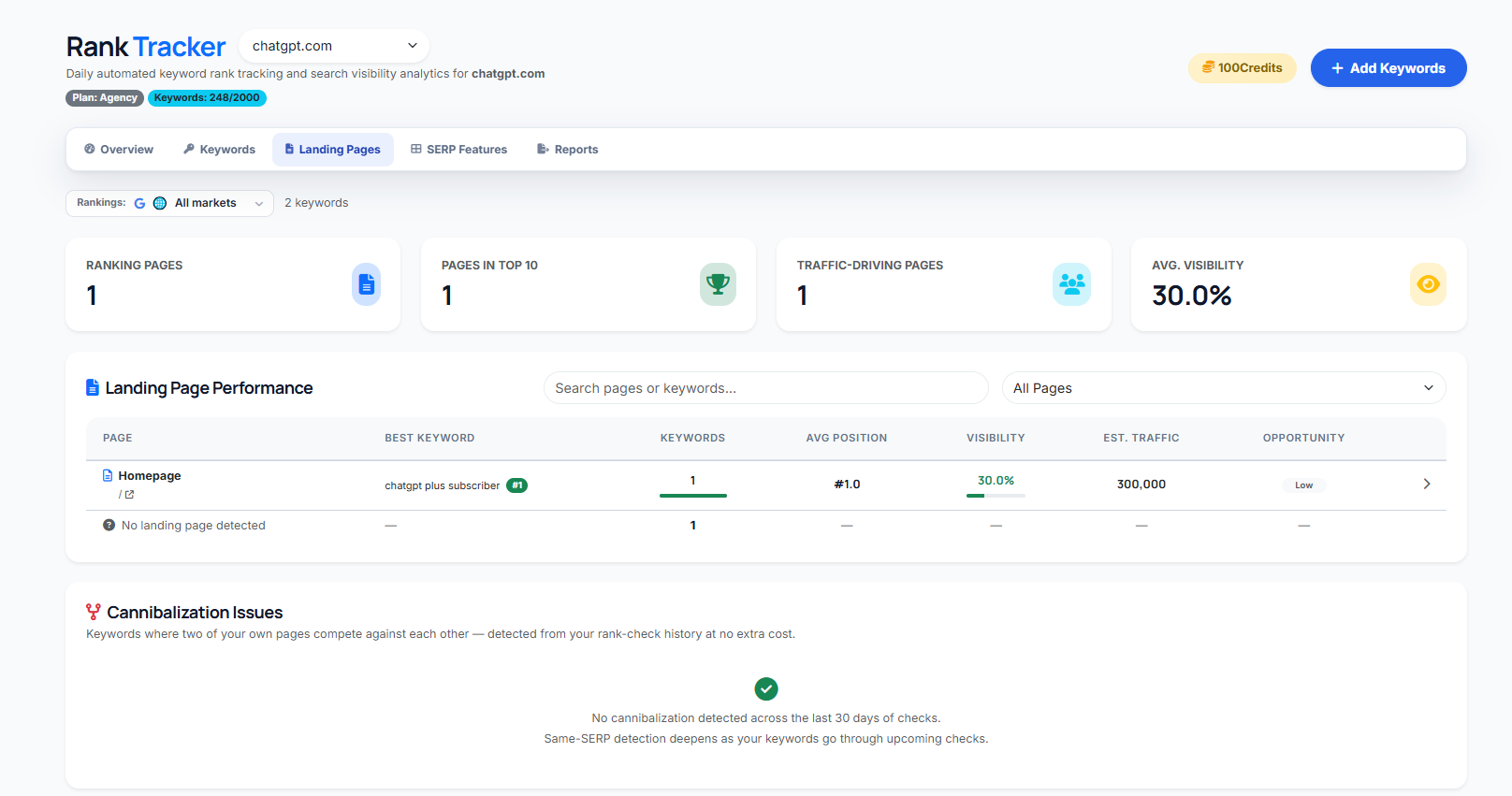
assets/img/sample-report/rank-tracker/4-landing-pages.png and refresh — it will appear here.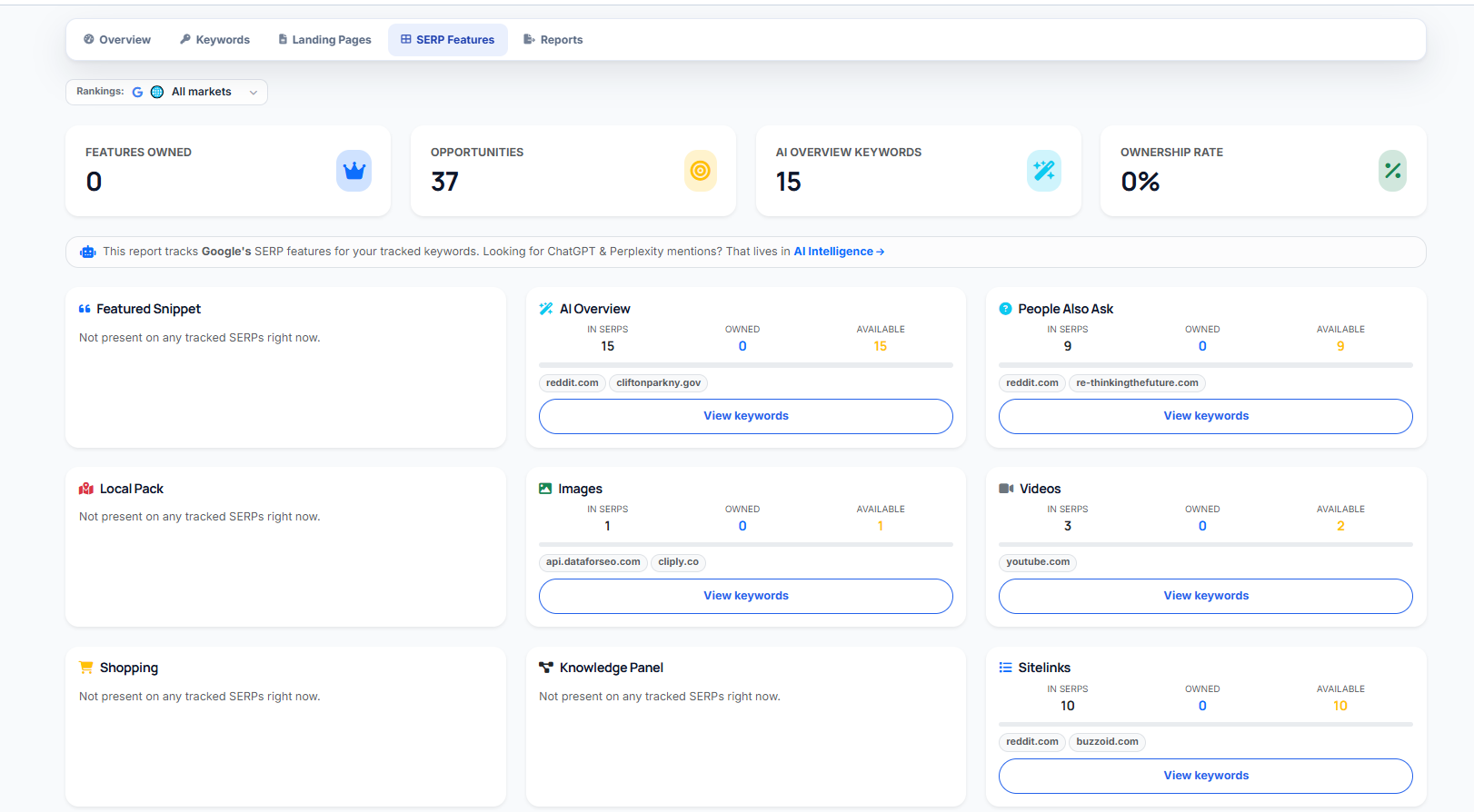
assets/img/sample-report/rank-tracker/5-serp-features.png and refresh — it will appear here.