
The command center for
how AI sees your brand.
See how ChatGPT, Gemini, Claude, Perplexity and Google AI Overviews discover, trust and cite your brand — with six auditable scores that turn "we're invisible in AI answers" into a weekly-tracked roadmap. Free scan, no credit card.
Executive KPI Cards
Sample Report — Illustrative DataThese six scores mirror exactly what SignalSumo's authenticated AI Intelligence Center computes from a real AI platform response. The numbers below are a sample, not a live analysis of any specific domain.
Sample Report — Executive Summary
Sample Report — Illustrative DataAcross the sample analysis, AI responses mention this domain prominently, cite it alongside authoritative sources, and use predominantly positive trust language. The clearest opportunity is deepening topical coverage in one core category, where a tracked competitor currently leads on citation share.
AI Response Simulator
Sample Report — Illustrative DataA preview of what SignalSumo's real, live analysis looks like for the prompt "What is the best SEO audit tool for a small marketing team?" — switch platforms to compare.
Citation Explorer
Every source an AI model cites gets classified into one of eight types, so you can see not just how many citations you have, but how authoritative and diverse they are.
Competitor Intelligence
AI visibility is relative — see the Competitor Comparison chart in the Analytics section below for how a domain stacks up against the other brands an AI model actually considers side-by-side.
AI Insights Panel
Weak topical authority in a core category
MediumContent on the primary product category is shallow compared to competitors' depth on the same subject.
Missing FAQ structured data
HighNo FAQPage schema detected on key pages, leaving AI systems to infer Q&A content from prose alone.
Competitor gaining citation share
HighA tracked competitor's citation count grew faster over the last analysis period.
Brand not yet recognized as a distinct entity
MediumNaming and details vary across directories and citations, making disambiguation harder for AI systems.
Missing E-E-A-T signals
MediumAuthor bios, credentials, and verifiable expertise markers are sparse or absent on key content pages.
Trust language trending positive
LowRecent analyses show a growing share of positive trust terms relative to negative ones — a sign of real progress.
Recommendation Center
Improve FAQ Schema
Add FAQPage schema to pages that already answer common questions in prose, so AI systems can extract them with certainty instead of inferring them.
See how this page does it in the Methodology section
Strengthen Topical Authority
Build a cluster of interlinked, in-depth content around your core topic rather than isolated one-off posts.
Read the Topical Authority section
Increase High-Quality Citations
Pursue coverage on sites AI models already treat as authoritative — industry publications, review platforms, and .edu/.gov resources.
Check your current backlink profile
Expand Entity Signals
Standardize your brand name and key details across your site, directories, and social profiles to reinforce entity recognition.
Read the Entity Optimization section
Publish Supporting Articles
Fill gaps in your topic cluster with clear, fact-forward articles a model can extract and cite confidently.
Review AI Search Best Practices
Improve Internal Linking
Link related pages together so both crawlers and AI systems can trace topical depth across your site.
Run a technical audit
Analytics
Every chart below includes what it measures, why it matters, how SignalSumo calculates it, and how to improve it — no unexplained numbers.
AI Visibility Trend
Sample data- What it measures
- Tracks the AI Visibility Score for a domain across repeated analyses over time.
- Why it matters
- AI models regenerate answers from fresh web crawls and retraining cycles, so visibility isn't static — a single snapshot can't tell you whether you're gaining or losing ground.
- How it's calculated
- Each point is the AI Visibility Score computed for the same domain/prompt pair on a given analysis date, using the formula described in the Methodology section.
- How to improve it
-
- Re-analyze the same domain/prompt combination monthly to build a real trend line.
- Publish new supporting content between analyses so there's something new for AI crawlers to pick up.
- Pair trend tracking with the Citation Growth chart below to see whether new citations are driving the movement.
- Key takeaways
-
- Visibility moves with fresh content and citations, not a one-time fix.
- A flat or declining trend is itself a signal worth investigating.
Citation Growth Timeline
Sample data- What it measures
- The number of distinct sources an AI model cited when answering questions about a domain, tracked over time.
- Why it matters
- More citations generally mean an AI model has more independent corroboration that a domain is a legitimate, relevant answer to a query — a thin citation list is easier for a model to ignore.
- How it's calculated
- Counts unique cited sources per analysis, deduplicated by domain, for the same prompt over each period shown.
- How to improve it
-
- Earn coverage on sites AI models already trust — review platforms, industry publications, and .edu/.gov resources.
- Ask satisfied customers or partners to publish content that references your site.
- Keep old citations alive — broken or removed pages stop counting.
- Key takeaways
-
- Citation count is a leading indicator for AI Visibility Score movement.
- Diversity of citing domains matters as much as raw count.
Brand Mentions by AI Platform
Sample data- What it measures
- Compares how often a domain is mentioned across different AI platforms for the same set of prompts.
- Why it matters
- Each AI platform draws on a different mix of crawl data, licensing deals, and retrieval methods, so visibility on one platform doesn't guarantee visibility on another.
- How it's calculated
- Demo data reflects the two platforms SignalSumo currently analyzes live (ChatGPT, Gemini); the remaining platforms are shown as directional estimates pending integration.
- How to improve it
-
- Don't optimize for a single AI platform — the sources that earn citations tend to be reused across models.
- Track platform-specific gaps once more providers go live in your account.
- Key takeaways
-
- Visibility is platform-specific, not universal.
- ChatGPT and Gemini are live in SignalSumo today; additional platforms are on the roadmap.
Citation Source Distribution
Sample data- What it measures
- Breaks down cited sources by type — Official Website, Government/Education, Encyclopedia, News/Publication, Review Site, Forum/Community, Directory, or Blog/Other.
- Why it matters
- A healthy citation profile is diverse. If every citation is a low-authority forum post, an AI model has less reason to treat a domain as an established answer.
- How it's calculated
- Every cited source is classified into one of eight categories using domain and keyword heuristics (the same classifier the authenticated tool uses).
- How to improve it
-
- Pursue coverage on Government/Education and News/Publication sources where relevant — they carry the highest authority weighting.
- Don't rely solely on directories or forums for citations.
- Key takeaways
-
- Diversity of source type is a real, measured input into Citation Quality Score.
- Official Website citations confirm an AI model can find and parse your own site directly.
Trust Signal Breakdown
Sample data- What it measures
- Counts the positive and negative trust-language terms an AI model used when discussing a domain.
- Why it matters
- AI models often editorialize when summarizing a brand — the vocabulary they use ("reliable" vs. "reported complaints") shapes how a reader interprets the recommendation.
- How it's calculated
- The response text is scanned for a defined list of positive terms (trusted, recommended, reliable, reputable, and similar) and negative terms (scam, warning, complaint, and similar).
- How to improve it
-
- Address the root cause of negative signals (unresolved complaints, security issues) rather than the wording alone.
- Publish clear trust pages — refund policy, security practices, verifiable credentials.
- Key takeaways
-
- Trust Score is directly built from this breakdown.
- Negative terms weigh roughly twice as heavily as positive terms in the score formula.
Competitor Comparison
Sample data- What it measures
- Compares a domain against its top two competitors across four core dimensions: Visibility, Trust, Citations, and Mentions.
- Why it matters
- AI visibility is relative — an AI model typically surfaces a short list of options, so what matters is how a domain stacks up against the alternatives it's actually being compared to.
- How it's calculated
- Each axis is the competitor's value for that metric (scaled 0-100) computed from the same analysis run as the primary domain.
- How to improve it
-
- Target the specific dimension where a competitor leads rather than trying to improve everything at once.
- Re-run the comparison after each round of content/citation work to confirm the gap closed.
- Key takeaways
-
- A domain can lead on Trust while lagging on Citations — the radar shape matters more than any single score.
Recommendation Confidence
Sample data- What it measures
- Shows how the current set of recommendations breaks down by priority — High, Medium, or Low.
- Why it matters
- Not every fix is equally urgent; this view helps teams sequence work instead of treating a long list as equally important.
- How it's calculated
- Each recommendation SignalSumo generates carries a priority tier based on its estimated impact and how directly it maps to a detected gap (missing schema, weak trust language, thin citations, and similar signals).
- How to improve it
-
- Clear High priority items first — they map to the gaps with the largest estimated score impact.
- Re-run analysis after resolving High priority items; the mix should shift toward Medium/Low over time.
- Key takeaways
-
- A shrinking "High priority" share over successive reports is a good sign of real progress.
Topical Authority Distribution
Roadmap preview- What it measures
- An illustrative view of how strongly a domain is associated with the topic clusters relevant to its industry.
- Why it matters
- AI models tend to favor sources that consistently cover a subject in depth over sources that mention it once — depth across a topic cluster is a strong signal of expertise.
- How it's calculated
- Roadmap concept: topical authority is not yet a score computed by the live SignalSumo backend. This chart illustrates the shape of the metric we're building toward, using sample data only.
- How to improve it
-
- Build content clusters around a topic rather than isolated one-off articles.
- Interlink related pages so both users and crawlers can trace topical depth.
- Key takeaways
-
- This is a preview of a planned metric, not a live SignalSumo score today.
Citation Velocity
Sample data- What it measures
- The rate at which new citations to a domain appear in AI responses, tracked week over week.
- Why it matters
- A sudden spike or drop in citation velocity often precedes a corresponding move in AI Visibility Score, making it a useful early-warning metric.
- How it's calculated
- Counts newly-observed citing domains per week that weren't present in the prior week's analysis for the same prompt.
- How to improve it
-
- Time content and PR pushes to create sustained velocity rather than a single spike.
- Investigate any sharp drop — it can indicate a citing source removed or de-indexed a page.
- Key takeaways
-
- Velocity is a rate, not a total — it shows momentum, not just volume.
AI Readiness Score Timeline
Roadmap preview- What it measures
- An illustrative composite view of how well-prepared a domain is for AI-driven discovery — blending visibility, trust, citations, and structured-data coverage into one directional trendline.
- Why it matters
- Teams evaluating a broad AI-visibility initiative often want one number to report on, even though the underlying work spans several distinct signals.
- How it's calculated
- Roadmap concept: AI Readiness is not a score the live backend computes today. It is shown here as sample data illustrating a planned composite metric, not a claim of an existing calculation.
- How to improve it
-
- Track the six real scores individually today — AI Visibility, Trust, Citation Quality, Source Authority, Competitor Rank, and Brand Mentions — the composite will build on these once released.
- Key takeaways
-
- This is a preview of a planned metric, not a live SignalSumo score today.
Learn: AI Visibility Optimization
What is AI Visibility?
AI Visibility is how consistently and favorably a brand appears when someone asks an AI platform — ChatGPT, Gemini, or a similar assistant — a question that brand could reasonably answer.
Traditional SEO measures whether a URL appears on a results page. AI Visibility measures something different: whether a brand gets mentioned, cited, or recommended inside a single generated answer that a user never has to click through to a search results page to see.
This matters because a growing share of research and buying decisions now start with a question typed into an AI assistant rather than a search box. If a brand never appears in that generated answer, it effectively doesn't exist for that moment of decision-making — regardless of how well it ranks in traditional search.
- AI Visibility is measured inside a generated answer, not a results page.
- It's possible to rank well in traditional search and still be invisible to AI-generated answers.
Traditional SEO vs. AI Visibility Optimization
| Dimension | Traditional SEO | AI Visibility Optimization |
|---|---|---|
| Primary goal | Rank a URL on a results page | Be cited or recommended inside an AI-generated answer |
| Unit of success | Page position (#1-#10) | Mention, citation, and trust language in a single generated response |
| Key signals | Backlinks, on-page keywords, Core Web Vitals | Entity clarity, citation diversity, trust language, structured data |
| Feedback loop | Rank tracking against a fixed query list | Re-running the same prompt to see how the generated answer changes |
| Content format | Long-form pages targeting a keyword | Clearly structured, fact-dense content a model can extract and quote |
How AI Search Works
Modern AI assistants answer questions using a mix of information baked into the model during training and, increasingly, live web results retrieved at the moment a question is asked.
When a model has live web access, it typically issues one or more search queries related to the user's question, retrieves a handful of results, reads through them, and synthesizes an answer — citing the sources it found useful along the way. This is functionally closer to a research assistant skimming search results than to a static lookup of memorized facts.
Because of this, a page's crawlability, load speed, and clarity still matter — a model can't cite content it can't successfully retrieve and parse. A technical SEO audit that surfaces crawl errors and slow pages is still a relevant first step even for AI-visibility work.
- Live AI search behaves like a research assistant reading search results, not a static database lookup.
- Technical crawlability is a prerequisite for AI citation, not a separate concern.
How LLMs Choose Sources
When an AI model has multiple candidate sources for a fact, it tends to favor ones that are clear, well-structured, corroborated by other sources, and easy to extract a confident answer from.
A page that states a fact plainly in the first few sentences is easier for a model to cite confidently than one that buries the same fact under marketing copy. Sources that are also independently confirmed by other citations tend to be treated as more reliable than a single self-published claim.
This is why concise, fact-forward writing tends to outperform dense marketing prose for AI citation purposes — not because it's "better" writing in a general sense, but because it's easier for a model to extract and quote with confidence.
- Clear, fact-forward writing is easier for a model to cite than dense marketing copy.
- Corroboration across multiple independent sources increases citation likelihood.
Understanding AI Citations
A citation, in the AI-visibility sense, is any source an AI platform references — explicitly or implicitly — while constructing its answer.
Some platforms show citations as visible links beneath the answer; others fold cited information into the prose without a visible source list. Either way, the underlying source material shaped what the model said, which makes it worth tracking even when it isn't displayed.
A strong citation profile isn't just about volume — a domain cited once by a respected industry publication can carry more weight than being cited five times by low-authority directories. This is the same principle behind why a backlink profile analysis looks at link quality, not just link count.
- Citations shape an AI answer even when they aren't visibly displayed to the user.
- Citation quality and diversity matter more than raw citation count.
Entity Optimization
An entity is a distinct, identifiable "thing" — a person, brand, product, or organization — that a search or AI system can recognize as a single consistent concept, separate from other entities that might share a similar name.
Entity optimization means making sure a brand is described the same way, with the same name and identifying details, everywhere it appears online — its own site, directory listings, social profiles, and press coverage. Inconsistency (different names, addresses, or descriptions across sources) makes it harder for any system, human or AI, to confidently treat those mentions as referring to the same thing.
This is closely related to how a competitor analysis maps out how clearly competitors have established themselves as distinct entities versus how easily they blend together in a category.
- Consistency in naming and details across the web strengthens entity recognition.
- A poorly-disambiguated entity is easy for an AI model to confuse with a similarly-named brand.
Strong Entity vs. Weak Entity
| Signal | Strong Entity | Weak Entity |
|---|---|---|
| Naming consistency | Same brand name used identically across the web | Brand name varies across listings, social profiles, and citations |
| Structured data | Organization/Product schema present and consistent | No structured data, or conflicting details across pages |
| Third-party confirmation | Referenced consistently by independent sources | Only self-published mentions exist |
| Disambiguation | Easily distinguished from similarly-named entities | Easily confused with unrelated businesses sharing the name |
Trust Signals
Trust signals are the cues — both textual and structural — that indicate whether a brand is reliable, legitimate, and safe to recommend.
For AI models, trust signals often show up as language patterns picked up from the web: consistent positive sentiment across reviews and coverage, versus recurring warnings or complaints. Structural signals matter too — clear ownership information, verifiable contact details, and transparent policies all contribute to how confidently a model recommends a brand.
Unlike a ranking factor that can be gamed with a single technical fix, trust signals accumulate from real-world reputation, so the most reliable way to improve them is to resolve the underlying issue driving negative sentiment, not just to publish more positive-sounding copy.
- Trust signals come from accumulated reputation, not a single on-page fix.
- Structural transparency (ownership, policies, contact info) reinforces textual trust language.
High Trust vs. Low Trust
| Signal | High Trust | Low Trust |
|---|---|---|
| Language AI models use | "Reliable", "recommended", "reputable" | "Reported issues", "complaints", "use caution" |
| Review presence | Consistent, verifiable positive reviews across platforms | Sparse, inconsistent, or predominantly negative reviews |
| Transparency | Clear ownership, contact information, policies | Missing or hard-to-find business information |
| Security posture | HTTPS, verifiable business registration | Missing basic security or verification signals |
Topical Authority
Topical authority describes how thoroughly and consistently a domain covers a given subject area, as opposed to mentioning it once in passing.
A site with a dozen deep, interlinked articles on a subject signals more authority on that subject than one with a single shallow post — both to human readers and to systems trying to judge expertise. AI models appear to draw on this same intuition when weighing which sources to trust for a subject-specific question.
Building topical authority is a long-term content strategy, not a one-time task, which is part of why SignalSumo treats it as a roadmap metric today rather than claiming a fully-computed score before the methodology is fully validated.
- Depth and consistency across a topic matter more than any single high-effort article.
- This is currently an illustrative/roadmap metric in SignalSumo, not a live computed score.
Knowledge Graphs
A knowledge graph is a structured map of entities and the relationships between them — for example, a company, its founder, its products, and its industry, all connected as distinct nodes.
Search engines and AI systems use knowledge graphs to understand context beyond a single page of text — knowing that a company operates in a particular industry, is headquartered in a particular place, or is related to particular products helps a system answer questions it was never explicitly given the exact wording for.
A brand doesn't need to build its own public knowledge graph to benefit from this — structured data markup and consistent entity information across the web feed into the knowledge graphs maintained by search and AI platforms themselves.
- Knowledge graphs connect entities and relationships, not just keywords.
- Structured data and consistent entity details are how a brand feeds into external knowledge graphs.
Structured Data
Structured data is markup — most commonly JSON-LD — added to a page that explicitly labels what its content means, rather than leaving a system to infer it from plain text.
A page can state in prose that it's a product page for a specific item at a specific price, but structured data states it in a machine-readable format a system doesn't have to guess at. Schema types like Organization, Product, FAQPage, and HowTo are among the most broadly useful for brands trying to be clearly understood by both search engines and AI systems.
This page itself uses several of these types — see the Methodology section for specifics — as a working example rather than just a description.
- Structured data removes ambiguity that plain text leaves for a system to infer.
- FAQPage, Organization, and HowTo schema are broadly useful starting points for most brands.
How SignalSumo Calculates Scores
Every score in the AI Intelligence Center is derived directly from a real API response returned by the AI platform being analyzed — not estimated, not simulated.
When you analyze a domain in the authenticated tool, SignalSumo sends your prompt to the selected AI platform (currently ChatGPT or Gemini), and the platform performs its own live web-search-enabled response. SignalSumo then parses that real response — its text, cited sources, and search results — and runs it through the scoring formulas described in the Methodology section.
No score is inferred from a generic industry benchmark or a cached snapshot; it reflects what that specific AI platform actually said, at that specific time, about that specific prompt.
- Scores come from a real API response, not an estimate.
- See the full Methodology section below for the exact formulas.
Score Interpretation Guide
| Range | Label | What it typically means |
|---|---|---|
| 75-100 | Strong | The domain is consistently mentioned, cited, and described in positive terms. |
| 50-74 | Developing | The domain appears sometimes but isn't consistently the AI's first choice — clear room to improve. |
| 0-49 | Needs Work | The domain rarely appears, or appears alongside negative trust language — treat as a priority. |
AI Search Best Practices
A short, practical list of habits that tend to improve AI visibility over time.
Write fact-forward, not marketing-forward
State what a product or service actually is and does in plain language before layering on positioning copy.
Add structured data to key pages
Organization, Product, and FAQPage schema give AI systems an unambiguous read on your content.
Keep brand details consistent everywhere
Same name, same description, same key facts across your site, directories, and social profiles.
Earn citations, don't just publish content
A mention from an independent, credible source outweighs a dozen self-published claims.
Re-test regularly
AI answers change as models retrain and re-crawl the web — a single analysis is a snapshot, not a permanent state.
Common Mistakes
Patterns that consistently hold brands back from AI visibility, based on what shows up in low-scoring reports.
Treating AI visibility as a one-time project
A single round of fixes without ongoing content and citation work tends to plateau quickly.
Optimizing only for one AI platform
The sources that earn citations are usually reused across models — a single-platform focus leaves visibility gaps elsewhere.
Ignoring negative trust language
Publishing more positive copy doesn't offset an unresolved complaint pattern an AI model has already picked up on.
Burying facts under marketing copy
If a model can't quickly extract a clear fact, it's less likely to cite the page with confidence.
Skipping structured data
Leaving a system to infer meaning from prose alone is strictly harder than stating it explicitly.
Future of AI Search
AI-generated answers are becoming a larger share of how people research questions that used to start with a search engine results page.
As more AI platforms add live web retrieval and as usage grows, the gap between "ranking well in traditional search" and "being cited well in AI answers" is likely to matter more, not less. Brands that treat these as the same problem risk missing the specific signals — entity clarity, citation diversity, trust language — that AI-generated answers actually weigh.
SignalSumo is building the AI Intelligence Center to track this shift as it happens: today that means ChatGPT and Gemini analysis, with additional platforms and metrics (see the roadmap notes throughout this page) planned as the space matures.
- AI-generated answers and traditional search rankings are related but increasingly distinct problems.
- The signals that matter for AI visibility — entities, citations, trust language — are measurable today, not just theoretical.
Methodology
SignalSumo computes every score below from the raw response an AI platform returns when asked a real question — not from a proprietary crawl or a third-party index. This section documents exactly what goes into each number so you can judge how much weight to give it.
How AI Visibility Score is calculated
A domain earns points for being mentioned directly in the AI's response text, for appearing among the sources it cites, and for appearing in the underlying search results the model drew on. Earlier appearances in either list are weighted more heavily than mentions buried at the bottom, on the theory that models — like readers — tend to lead with what they consider most relevant.
How Trust Score is calculated
Trust Score starts from a neutral midpoint and moves up or down based on a defined vocabulary of positive terms (reliable, recommended, reputable, and similar) and negative terms (scam, warning, complaint, and similar) detected in the response text. Negative terms are weighted more heavily than positive ones, since a single credible warning tends to outweigh several generic compliments in how a reader reacts.
How Citation Quality Score is calculated
Citation Quality blends four inputs: how many sources were cited, how many unique domains those sources span, what share of them carry a visible publish date, and what share sit on authoritative .gov/.edu/.org domains. A response with three citations from the same domain scores lower than one with three citations spread across three independent, dated sources.
How Source Authority Score is calculated
Every cited source is classified into an authority tier — Government/Education and Official Website sources sit at the top, Encyclopedia and News/Publication next, then Review Sites and Directories, with Forums and uncategorized Blog/Other sources at the bottom. The score is the average tier value across every citation returned.
Confidence & data sources
Live scores are computed directly from a single API call to the AI platform being analyzed (currently ChatGPT and Gemini), using the platform's own web-search-enabled response. SignalSumo does not fabricate or estimate a platform's answer — the underlying text is real output from that model at the time of the query.
Update frequency
Because AI models regenerate answers from evolving crawl data and periodic retraining, the same prompt can return a different answer on a different day. SignalSumo does not silently re-score a saved report — it timestamps every analysis and lets you re-run it on demand to see what changed.
Known limitations
Scores reflect one prompt, one AI platform, one point in time — they are a sample, not a census of every possible query about a brand. A domain can score well on one prompt and poorly on a closely related one. Treat each report as a data point, not a verdict, and re-test with multiple prompts before drawing conclusions.
AI Search Glossary
Plain-language definitions for the terms used throughout this page.
AI Visibility
How consistently and favorably a brand is mentioned, cited, or recommended inside AI-generated answers, as opposed to how it ranks on a traditional search results page.
AI Citation
A source an AI platform references — visibly or implicitly — while constructing an answer, whether or not that source is displayed as a clickable link.
Knowledge Graph
A structured map of entities (people, brands, products, organizations) and the relationships between them, used by search and AI systems to understand context beyond individual pages.
Entity
A distinct, identifiable "thing" — such as a company, product, or person — that a system can recognize as a single consistent concept across multiple mentions.
Entity Recognition
The process by which a system identifies mentions of entities within text and links them to a consistent underlying concept, rather than treating each mention as unrelated text.
Entity Confidence
How certain a system is that a given mention refers to a specific, correctly-identified entity, rather than a different entity with a similar name.
Topical Authority
How thoroughly and consistently a domain covers a given subject area, as judged by the depth and interconnection of its content on that topic.
Structured Data
Machine-readable markup, most commonly JSON-LD, added to a web page that explicitly labels what its content means rather than leaving it to be inferred from plain text.
Trust Signal
Any textual or structural cue — positive or negative language, verifiable ownership information, consistent reviews — that indicates whether a brand is reliable and safe to recommend.
Source Authority
A classification of how authoritative a cited source is, based on its type (Government/Education, Encyclopedia, News, Review Site, Forum, and similar tiers), not a proprietary third-party ranking metric.
Retrieval-Augmented Generation (RAG)
A technique where an AI model retrieves relevant documents or search results at the moment a question is asked, then generates its answer using that retrieved material alongside what it learned during training.
Hallucination
When an AI model states something confidently that isn't supported by its training data or retrieved sources — a known failure mode that makes clear, well-corroborated source material more valuable, not less.
Semantic Search
A search approach that matches queries to results based on meaning and context rather than exact keyword matching, which is part of how modern AI-driven search surfaces relevant sources.
AI Readiness
A roadmap concept SignalSumo is developing: a composite view of how well-prepared a domain is for AI-driven discovery, blending visibility, trust, citations, and structured-data coverage. Not a live computed score today.
Frequently Asked Questions
Resources
Public API Reference
Coming Soon
Release Notes
Coming Soon
Explore Our Full SEO Suite
Technical SEO Audit
Crawl your site for the errors that also block AI systems from reading it.
Learn More →Backlink Checker
See who links to you — the same signal AI models weigh as third-party corroboration.
Learn More →Search Intent Checker
Understand what searchers — and the AI systems answering them — actually want.
Learn More →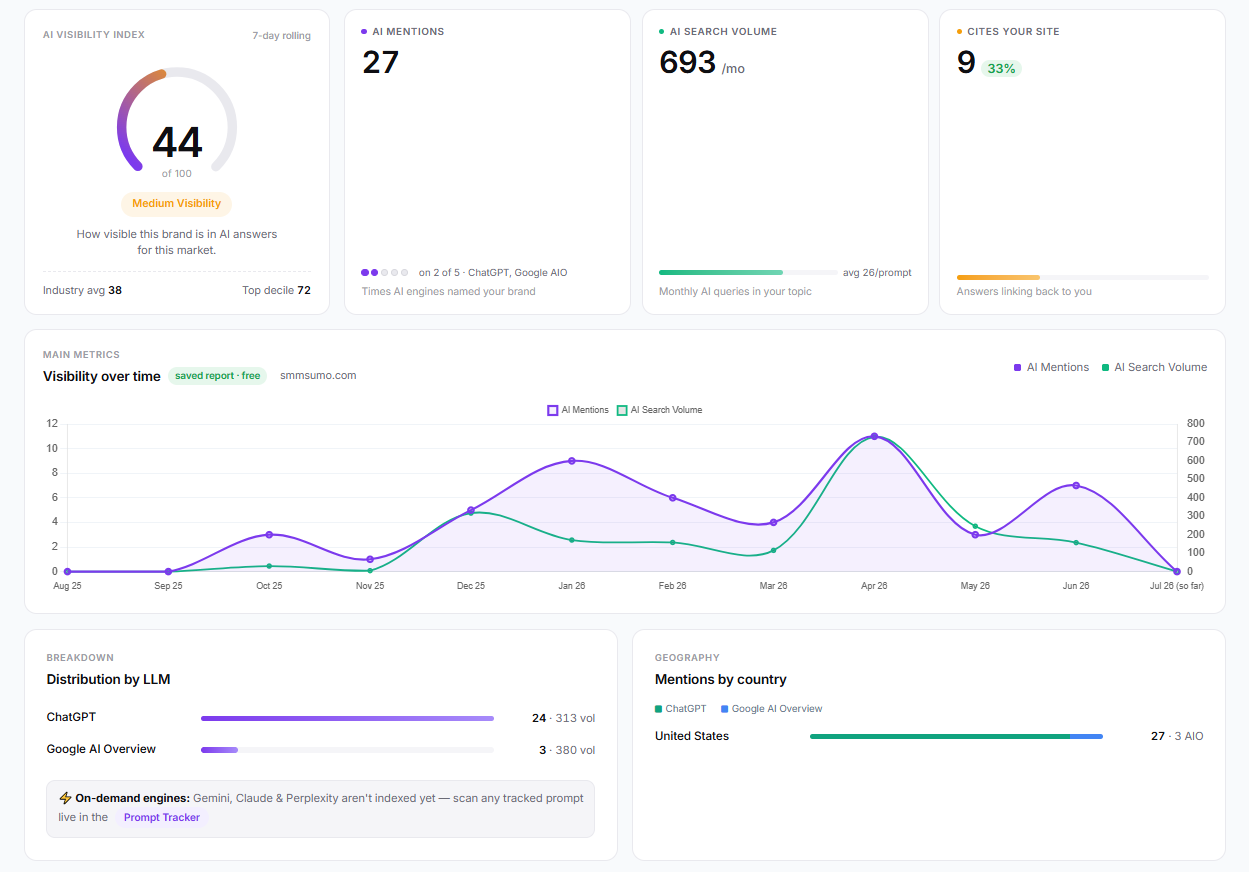
assets/img/sample-report/ai-intelligence/1-visibility-index.png and refresh — it will appear here.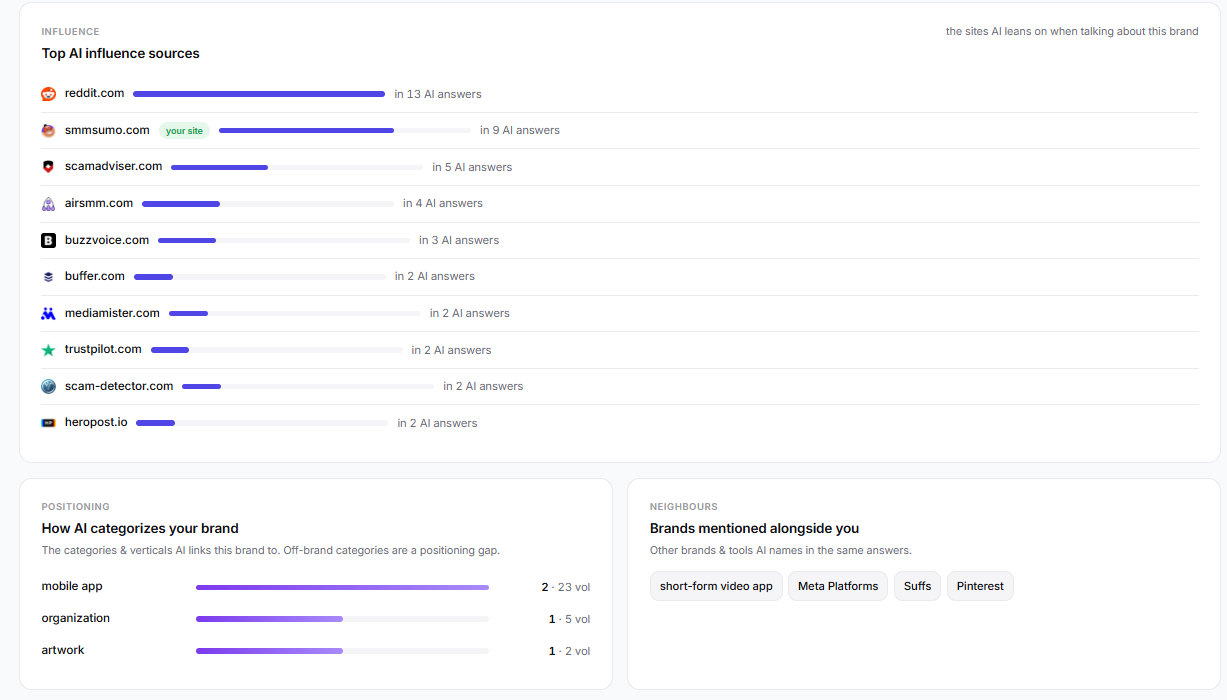
assets/img/sample-report/ai-intelligence/2-visibility-over-time.png and refresh — it will appear here.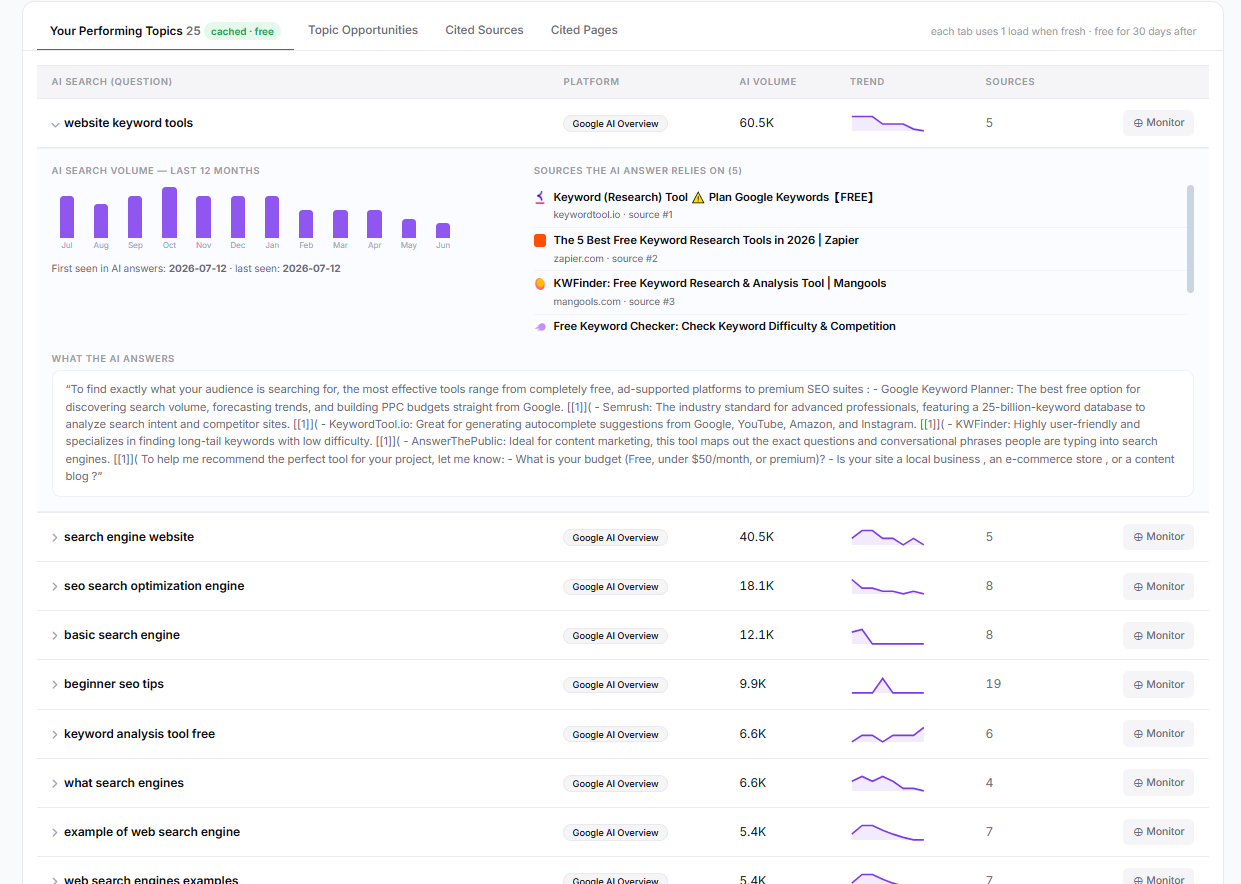
assets/img/sample-report/ai-intelligence/3-influence-sources.png and refresh — it will appear here.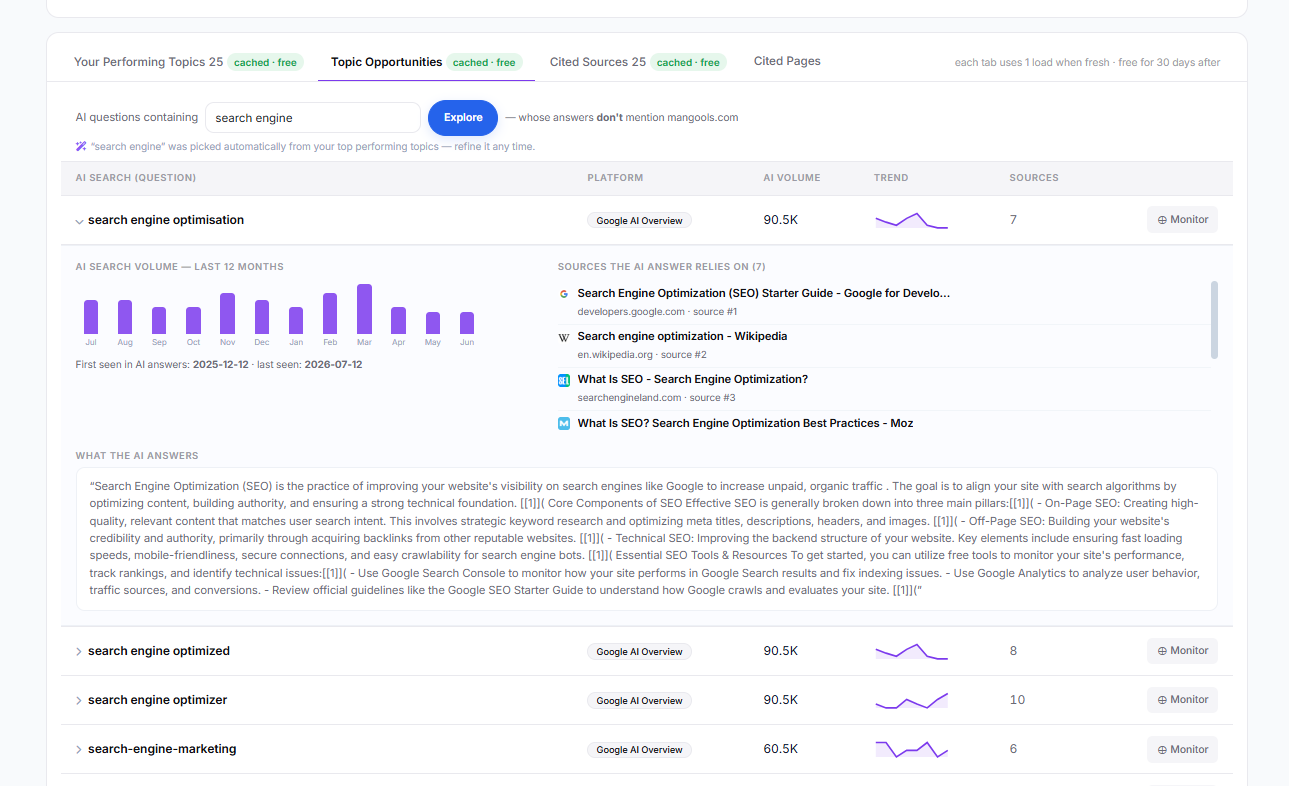
assets/img/sample-report/ai-intelligence/4-performing-topics.png and refresh — it will appear here.