
Generate SEO-ready articles.
See every fix before you take it.
Write full articles with AI, then grade the draft against a Search Readiness Score assembled from 20 named rules — on-page match, topical coverage, answer-engine readiness, search intent, off-page and technical fit. Every AI fix is previewed with its exact score change before it touches your document. Rank in Google and get quoted by AI answer engines.
FAQ block present +4 · Definition sentences present +2. Estimated CTR +0.4%.
From a keyword to a graded article in under a minute.
Give the AI a keyword. It pulls a brief from the current top-ranking pages, writes the article, and scores it against 20 named rules — the same Search Readiness Score you get inside the authenticated workspace. Then it offers to fix what is short, one preview at a time.
Enter a target keyword
Give the writer the keyword you want to rank for. It pulls a research brief — target word count, outline, question set, related entities and cited sources — from the current top-ranking pages.
Generate a full article
The writer drafts the whole piece to that brief. Every heading, section and paragraph stays editable, and the score re-computes as you type rather than on save. Regenerate a single section or rewrite one paragraph against a different keyword — no full rerun needed.
Take the fixes you agree with
Each failing rule comes with an offer to fix it. You see the proposed text, the score it would produce, which rules move, and a labelled confidence tier — then accept, edit first, or reject. Publish when the score is earned, not when you feel done.
An AI writer that has to show its work.
Every draft is scored against named, weighted rules drawn from what classical search ranks and what answer engines quote — surfaced in the workspace as you write, not in a separate audit afterward. And every fix the AI offers arrives as a preview, never as a change you discover later.
AI content generation
Long-form articles, section rewrites, intros, outros and outlines. Multiple AI providers sit behind one interface with automatic failover — no provider dropdown to babysit, and no dead tool when one of them has a bad afternoon.
Search Readiness Score — 20 rules
One 0–100 score assembled from 20 individually weighted rules that add up to exactly 100. Each shows what it found, what it wanted, what it is worth, and how to earn it. Nothing on the score is unattributed.
Preview before apply
Every AI fix runs as a simulation first: proposed text, score before, score after, which rules move, estimated CTR change, and a confidence tier with its reasons. Accept it, edit it first, or reject it. Nothing lands unseen.
Answer-engine readiness
A scored category of its own, built from five explicit rules: a direct answer inside the first 200 words, an FAQ block, supporting statistics, schema markup and definition sentences — the structure that decides whether an answer engine can quote you.
Brief-driven writing
The AI writes to a real brief pulled from the current top-ranking pages — target word count, outline, question set, related terms and sources — not to a blank prompt. That is what makes the output competitive out of the gate.
An outage reads as an outage
If a provider fails, you are told, and nothing is created — no proposal, no score change, no version of your document. A failed generation never quietly returns your own text back to you, and never spends your allowance.
Twenty rules. A hundred points. No unattributed score.
A score you cannot interrogate is a rumour. Every one of the 100 points belongs to a named rule that reports the value it found, the value it wanted, what it is worth, and the instruction for earning it — grouped into six categories so you can see which part of the page is weak rather than only that the number is low.
- On-page match — keyword in the title, in the H1 and in the slug, density inside a sane range, and alt text that actually describes the image.
- Topical coverage — the critical, recommended and additional terms the ranking pages treat as table stakes, scored by how many yours covers.
- Answer-engine readiness — a direct answer inside the first 200 words, an FAQ block, supporting statistics, schema markup, and definition sentences. This is what makes a page quotable.
- Search intent match — whether the page format fits what the query is actually asking for, and whether a commercial query gets the comparison table it expects.
- Off-page fit — your referring domains measured against the top-10 average for the keyword, so a content fix is not blamed for an authority gap.
- Technical fit — crawlable and indexable, canonical tag present, mobile-friendly, and LCP inside target. The foundation the writing sits on.
Score by category
What is costing you points
Passing
AI Content Writer — the questions people actually ask.
What is the AI Content Writer?
The AI Content Writer generates full articles, briefs and section rewrites, then grades every draft against a Search Readiness Score built from 20 named rules covering on-page match, topical coverage, answer-engine readiness, search intent, off-page fit and technical fit. You get the article and the reason it will or won't rank, in one workspace — and every AI-authored change is previewed with its exact score impact before it touches your document.
What is the Search Readiness Score?
A single 0–100 score assembled from 20 individually weighted rules whose weights add up to exactly 100. Nothing is a black box: every point on that score belongs to a named rule, and each rule shows the value it found, the value it wanted, the points it is worth, and the specific instruction for earning them. The score is grouped into six categories — On-page match, Topical coverage, Answer-engine readiness, Search intent match, Off-page fit and Technical fit — so you can see which part of the page is weak, not just that the number is low.
What does it mean that every AI fix is previewed?
Every AI action runs as a simulation first. You ask for a fix, and before anything is written you are shown the proposed content, the score you have now, the score the change would produce, which individual rules move and by how much, an estimated click-through change, and a confidence tier with the reasons behind it. Then you accept it, edit it first, or reject it. Nothing is committed to your document that you have not already seen — there is no button in this tool that changes your content sight-unseen.
What happened to the per-engine GEO Readiness scores?
They were replaced by something more useful. Instead of three separate engine scores, answer-engine optimization is now a scored category inside the one Search Readiness Score, made of five explicit rules: a direct answer within the first 200 words, an FAQ block, supporting statistics, schema markup, and definition sentences. Those are the structural properties that actually decide whether an answer engine can quote you, and each one names the fix rather than handing you a per-engine number with no instruction attached.
Does the AI writer follow a brief?
Yes. Give it a target keyword and it pulls a research brief — target word count, outline, question set, related terms and cited sources from the current top-ranking pages — then writes the full article to that brief. You can also generate section by section, regenerate a single heading, or rewrite existing paragraphs against the target keyword without rerunning the whole piece.
What happens if the AI fails to generate something?
You are told, plainly. If the provider errors or is unavailable, the request fails with the real reason and nothing is created — no proposal, no score change, no version of your document. This matters more than it sounds: an earlier build failed 'safely' by handing back your unchanged text, which scored identically and therefore appeared as a weak-but-successful suggestion. An outage that reads as a weak suggestion is a lie with a clean audit trail, so it now reads as an outage and the button stays ready to retry.
How is this different from a general-purpose AI writer?
A general-purpose AI writer hands you a draft and leaves the SEO work to you. This grades that draft against named, weighted rules for both classical search and answer engines, tells you which rule is costing you which points, offers to fix each one, and shows you the exact score change before you accept. You leave with content you can defend, not a blob you still have to hand-optimize and hope about.
How many articles can I generate?
Per-plan monthly caps are set in Plan Limits. Free accounts get a trial allowance and paid plans scale with tier; the current numbers sit on the Pricing page. Two details worth knowing: fixes that are mechanical string work, such as rewriting a title or slug, are not metered at all because no model is called, and a failed generation never consumes your allowance.
Can I edit the AI draft after generation?
Yes — output lands in the authenticated workspace where every paragraph, heading and image is editable, and the Search Readiness Score re-computes as you type rather than on save. You can also take an AI proposal into edit mode, change it, and apply your version instead of the model's. Regenerate a section, rewrite a paragraph against a new keyword, or export the whole article. No lock-in.
Explore the SignalSumo AI SEO suite.
The AI Content Writer sits inside the broader SignalSumo toolchain — pair it with keyword research to source targets, with the AI Visibility Tracker to measure whether the content actually gets cited, and with the technical audit to catch on-site issues that block ranking.
Write once. Ship it graded.
Stop shipping AI drafts that need an audit afterward, and stop accepting AI edits you never saw. Generate content that earns its score against named rules — for Google and for every answer engine that might quote you.
Start writing free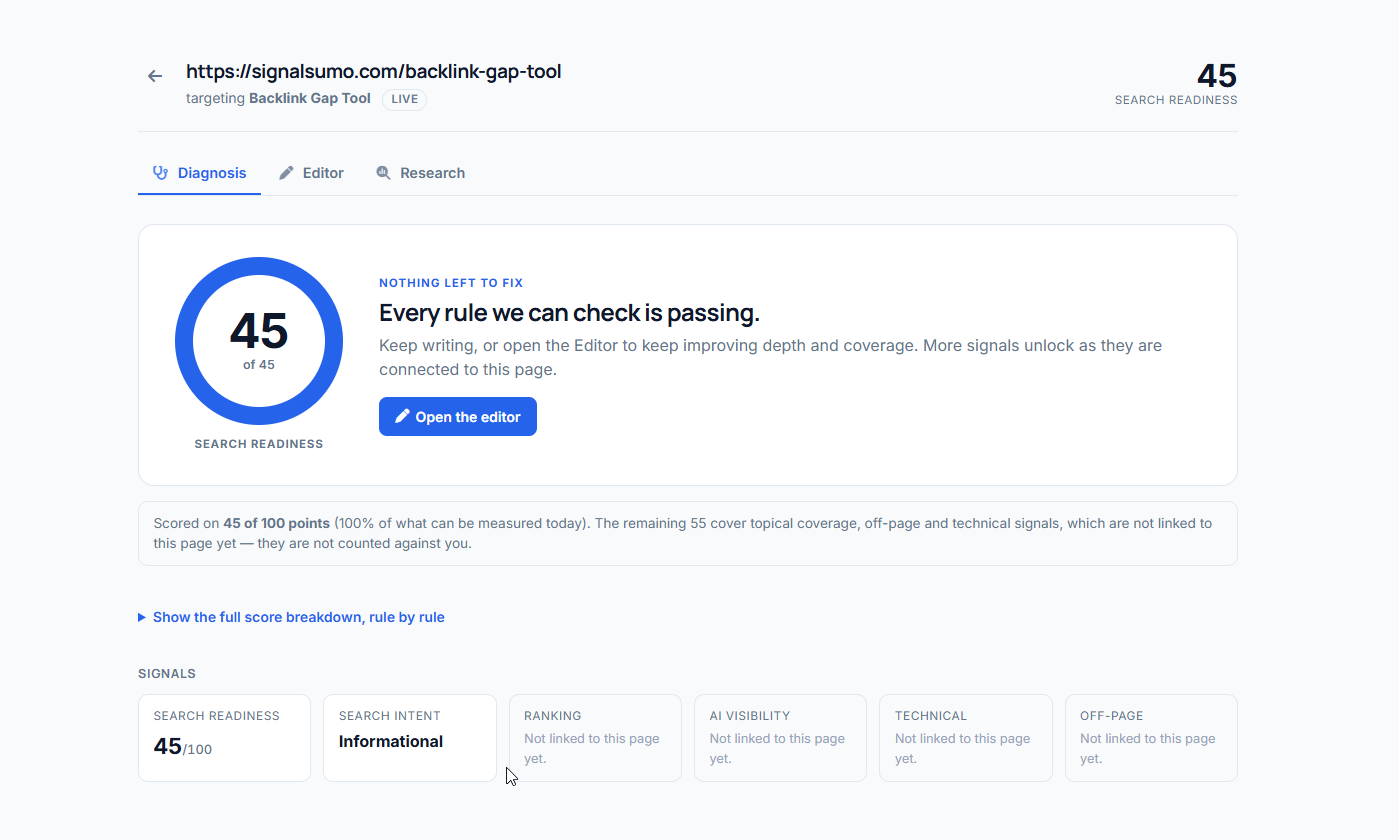
assets/img/sample-report/content-writer/content-optimizer-1.png and refresh — it will appear here.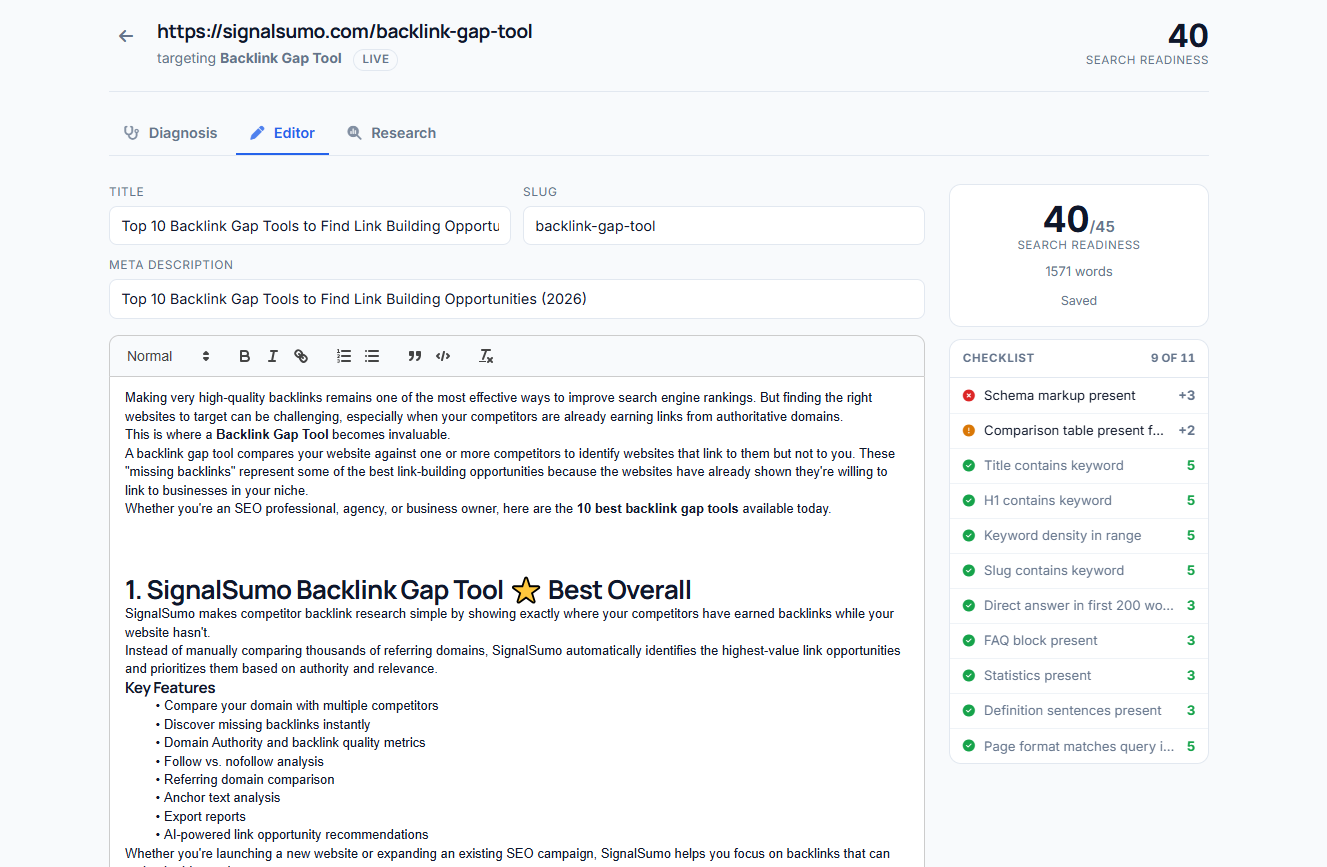
assets/img/sample-report/content-writer/content-optimizer-2.png and refresh — it will appear here.